



For a while, the promise around AI in development sounded simple.
Faster work. Lower costs. Smaller teams.
And in the early stages, it really does feel that way. Features appear quicker, prototypes come together in days instead of weeks, and the overall pace of development seems to accelerate.
But by 2026, many teams are starting to see a more complex reality.
Because once AI moves from experimentation into real product development, the question changes.
It’s no longer “Is AI faster?”
It becomes “What does AI actually cost?”
Table of Contents
Where the Savings Are Real
There are parts of development where AI genuinely reduces cost.
Work that used to take time simply because it was repetitive writing boilerplate, setting up basic structures, navigating documentation can now be completed almost instantly. That reduction in effort is real, and it translates directly into lower initial development cost.
In early-stage projects, this creates a noticeable shift. Teams can move from idea to working version much faster, which reduces the cost of experimentation and shortens feedback loops.
At this level, AI does exactly what it promised.
It removes friction.
Where the Cost Comes Back
The challenge appears later, when speed meets complexity.
AI-generated code is often correct in isolation, but real systems are rarely built in isolation. As features grow and systems evolve, small inconsistencies begin to surface. Edge cases appear. Architectural decisions start to matter more.
At this point, teams don’t just write code, they begin to spend time understanding, validating, and sometimes correcting what was generated earlier.
This creates a subtle but important shift.
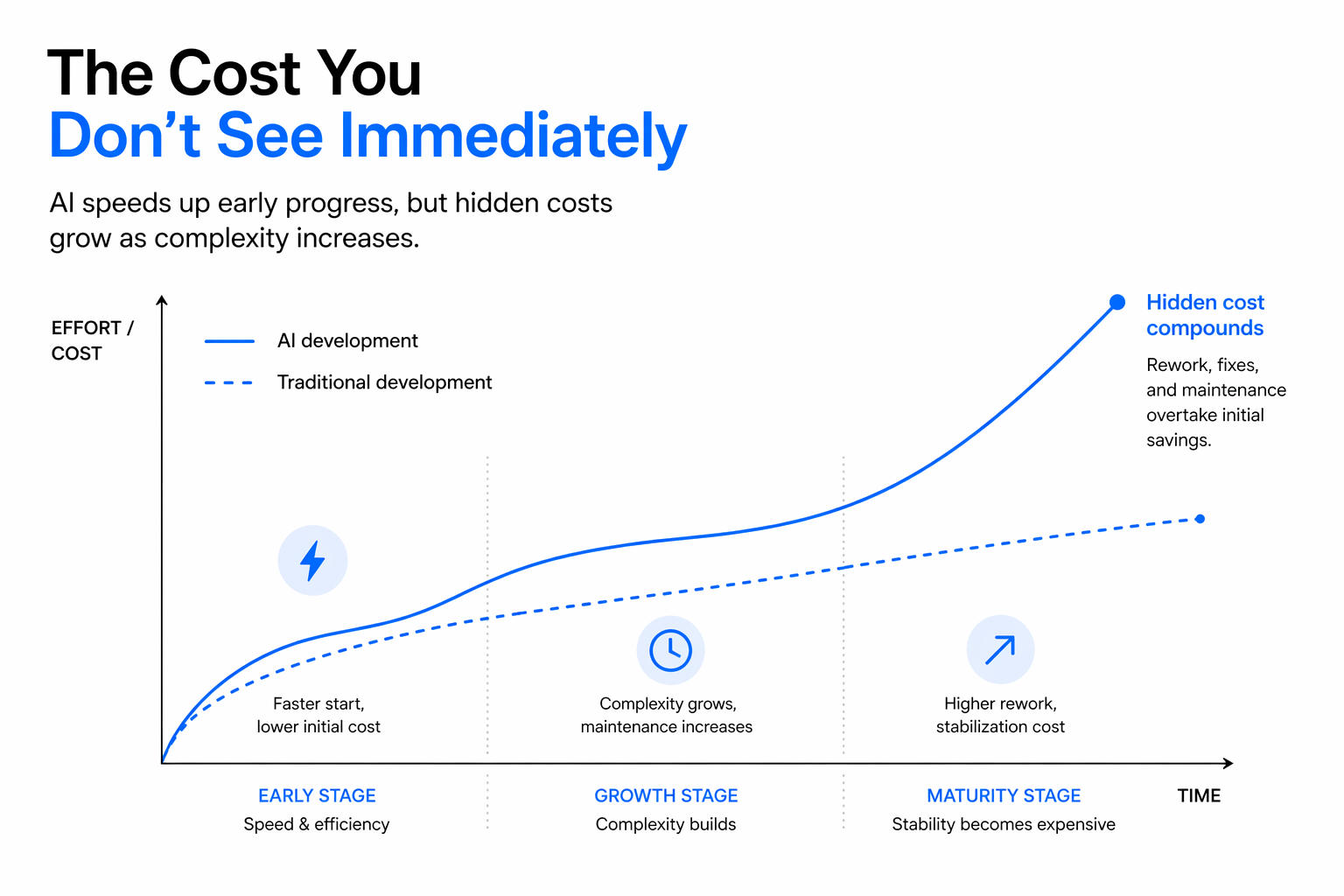
The time saved at the beginning doesn’t disappear, but part of it returns in a different form. Instead of writing from scratch, teams spend more time reviewing, aligning, and stabilizing.
And that work is harder to estimate.
The Cost You Don’t See Immediately
One of the biggest impacts of AI in development is not visible in the initial budget.
It shows up over time.
When systems grow faster than they are structured, maintenance becomes heavier. Small issues compound. Fixing one thing can unexpectedly affect another. Delivery slows down not because of lack of progress, but because of increasing complexity.
This is where cost stops being about hours and starts being about stability.
Because instability has a price:
more fixes, more rework, more coordination, more time spent understanding what already exists.
And unlike initial development, this cost is continuous.
But what’s actually happening is more nuanced.
As AI handles simpler tasks, the value shifts toward engineers who can manage complexity. The work itself doesn’t disappear, it changes shape. Instead of focusing on execution, more time is spent on decision-making, validation, and maintaining system integrity.
This kind of work requires experience.
So while AI reduces effort in some areas, it increases the importance of those who can keep everything under control. And that doesn’t lead to cheaper development, it leads to a different cost structure.
Less effort on writing.
More value in thinking.
What Companies Are Really Paying For
By now, it becomes clear that development cost is no longer just about how fast something can be built.
It’s about how well it can be sustained.
AI can make the start of a project cheaper. But it doesn’t guarantee that the system will remain stable, predictable, or easy to evolve.
And this is where the real cost decision is made.
Not in how quickly features appear, but in how much effort is required to keep them working over time.
Teams that treat AI as a shortcut often see faster early progress, followed by slower and more expensive stabilization.
Teams that integrate AI carefully tend to move slightly slower at first, but maintain control, which keeps long-term costs lower.
Summary
AI is changing the economics of development, but not by simply making everything cheaper.
It reduces the cost of writing code, but increases the importance of maintaining structure and stability. Some parts of the process become faster and more efficient, while others become more demanding and complex.
As a result, cost doesn’t disappear, it shifts.
The companies that benefit most are not the ones trying to minimize cost at the start, but the ones that understand where AI creates real savings and where it introduces long-term risk.
Because in modern development, the real question is not how little you spend today.
It’s how much control you keep tomorrow.














No comments yet.
Give us your impression about this article.