



Over the past two years, AI has quietly moved from being an experiment to becoming part of everyday development workflows. Tools that generate code, suggest fixes, and even design architecture are no longer futuristic – they’re already here, embedded in IDEs and daily routines.
And with that shift came a bold promise: development will become dramatically faster, cheaper, and more efficient.
But if you talk to engineering teams today, the reality feels… less clear.
Yes, things are moving faster.
But also messier.
More productive, but sometimes more chaotic.
So what is actually changing?
Table of Contents
The Speed Is Real. But It’s Not Where You Expect
AI undeniably accelerates certain parts of development. The most obvious one is the elimination of repetitive work.
Tasks that used to take hours writing boilerplate code, setting up endpoints, scaffolding components can now be done in minutes. For early-stage projects, this feels like a breakthrough. Teams move faster, prototypes come together quickly, and ideas are validated sooner.
There’s also a noticeable shift in how developers approach research. Instead of searching through documentation or forums, they ask AI directly. This reduces friction and speeds up decision-making in small but meaningful ways.
At first glance, it feels like a clear win.
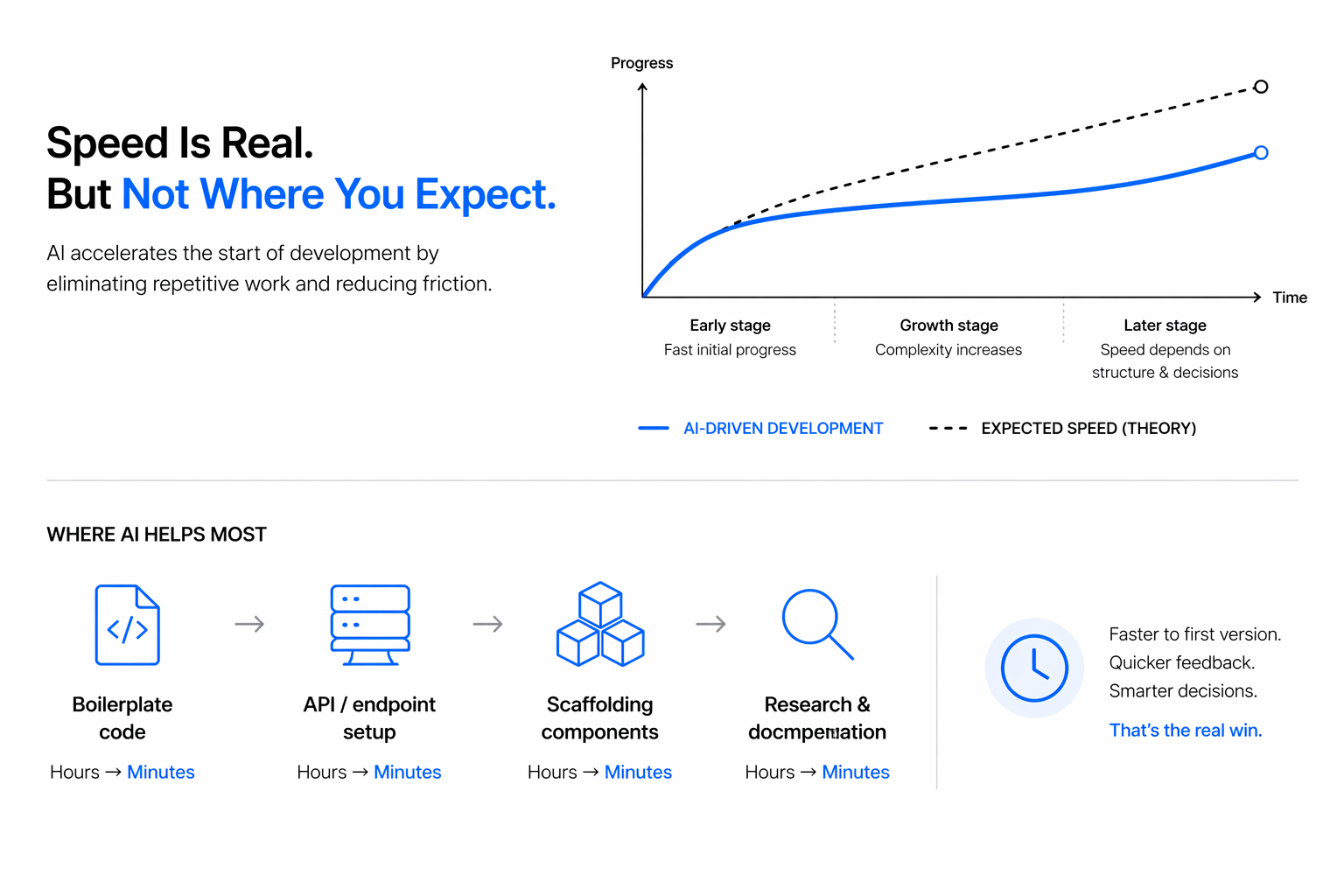
Speed at the Start, Friction Later
What many teams begin to notice after the initial boost is that the speed doesn’t always carry through.
AI-generated code often looks correct, but doesn’t fully account for real-world complexity. Edge cases are missed. Architectural decisions are inconsistent. Small inaccuracies compound over time.
Developers end up spending more time reviewing, validating, and sometimes rewriting what was generated.
So while the start of the process becomes faster, the middle and end often become heavier.
This creates a subtle shift:
you’re no longer just writing code, you’re constantly verifying it.
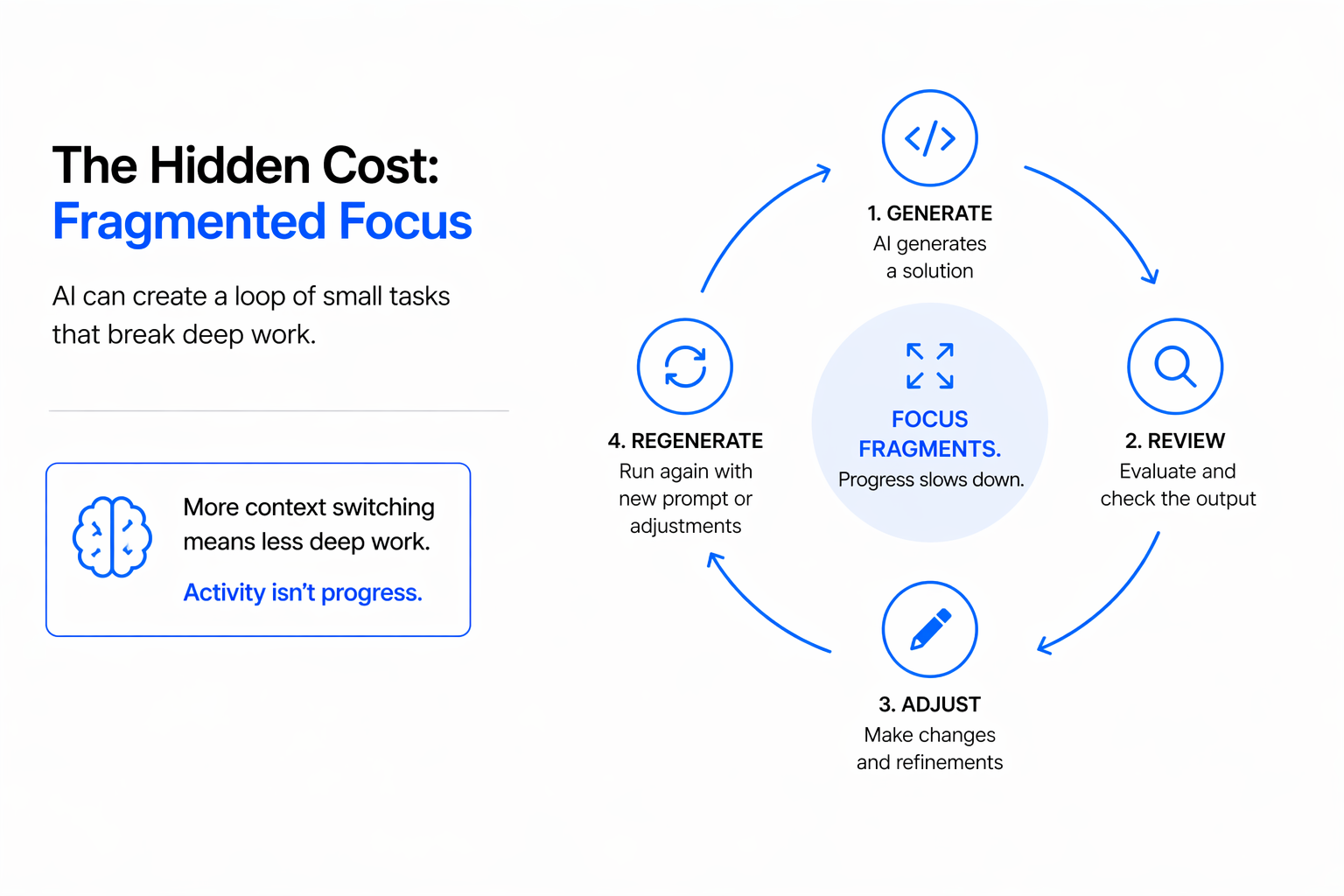
The Hidden Cost: Fragmented Focus
One of the less discussed side effects of AI in development is how it changes attention.
Instead of staying in deep work, developers often move through a loop:
generate → review → adjust → regenerate.
Each step is small, but together they fragment focus.
You’re no longer fully immersed in solving a problem: you’re managing outputs, prompts, and corrections. Over time, this can feel less like engineering and more like coordination.
Ironically, a tool meant to improve productivity can end up increasing context switching – the very thing that slows teams down.
More Code Doesn’t Mean Better Progress
Another pattern we see across teams is the illusion of productivity.
With AI, more code is produced. Tasks appear to move faster. Backlogs shrink more quickly.
But when you look deeper, the picture changes.
Are features actually being delivered faster?
Is the system more stable?
Is there less rework?
Often, the answer is not as positive as it seems.
The volume of output increases, but so does the amount of correction, adjustment, and maintenance.
Without clear visibility, it becomes difficult to tell whether the team is truly progressing or just moving faster in place.
Why the “10x Developer” Narrative Persists
The idea of a “10x developer” didn’t start with AI, but AI has amplified it.
It’s easy to believe that giving developers powerful tools will multiply their output.
In reality, AI doesn’t transform developers into something fundamentally different. It amplifies what’s already there.
Strong engineers use AI to accelerate thinking, explore options, and remove friction.
Weak processes use AI to scale mistakes faster.
So instead of creating “10x developers,” AI tends to create:
faster loops: both good and bad.
What Actually Matters Now
The real shift AI brings isn’t just about speed – it’s about uncertainty.
Teams can no longer rely on intuition alone to understand performance.
What feels faster may not be better.
What looks efficient may hide growing complexity.
The only way to navigate this is through clarity.
Not assumptions. Not hype. But actual visibility into how work is happening.
- Where is time really going?
- Is effort shifting from building to fixing?
- Are delivery timelines improving or just fluctuating?
- Is focus increasing or becoming fragmented?
These questions didn’t matter as much before.
Now they define whether AI becomes an advantage or a liability.
A More Grounded Perspective on AI in Development
AI is not a shortcut to better engineering.
It’s a multiplier.
If your processes are structured, it accelerates them.
If your workflows are unclear, it amplifies the chaos.
The teams that benefit the most are not the ones using AI the most aggressively, but the ones that stay aware of its impact.
They observe.
They adjust.
They measure.
And most importantly, they don’t confuse activity with progress.
Summary
AI is already changing development, but not in the simple way it’s often described.
Yes, it makes some things faster.
Yes, it lowers certain barriers.
But it also introduces new layers of complexity that didn’t exist before.
The question is no longer whether AI should be used.
It’s whether teams can stay in control of what it’s doing to their workflow.
Because in the end, the goal isn’t to write more code.
It’s to build better systems with clarity, focus, and intent.














No comments yet.
Give us your impression about this article.