



Over the past year, AI has become a real force in software development. It’s no longer just an assistant, it actively participates in how code is written, reviewed, and shipped.
And naturally, this raises a question many companies are starting to ask:
If AI can generate code, do we still need outsourcing teams?
At first glance, the idea of replacing teams with tools seems logical. Development appears faster, cheaper, and more accessible than ever before.
But that conclusion only holds if you look at development as a series of isolated tasks.
In reality, building software is something very different.
Table of Contents
Where AI Actually Changes the Game
AI is undeniably effective in areas where the work is structured and predictable. It removes friction from execution and speeds up processes that used to take significant time.
Today, AI can:
- generate boilerplate code in seconds
- accelerate debugging and research
- support rapid prototyping and experimentation
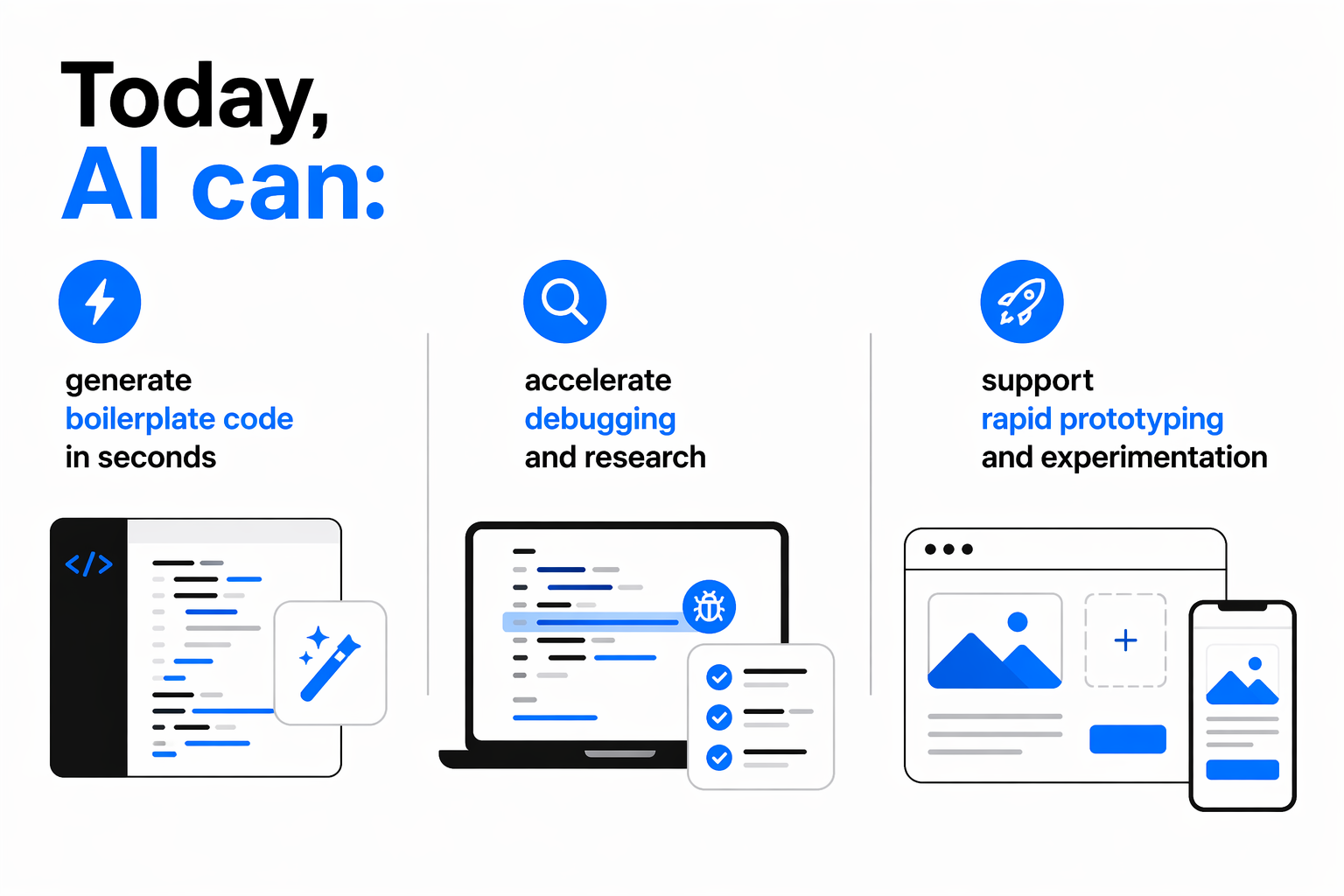
In these scenarios, the benefits are real. Teams move faster, ideas are tested sooner, and early-stage development becomes more efficient.
This is the part of the story that creates the impression that teams might become less necessary.
But that impression fades as soon as complexity enters the system.
The Moment Complexity Appears
Real-world development rarely follows a clean, predictable path.
Requirements evolve while work is already in progress.
Priorities shift due to business needs.
Unexpected issues surface at the worst possible time.
At this point, the problem is no longer “how to write code faster.”
It becomes “how to move forward without losing control.”
AI can generate solutions, but it doesn’t understand the broader system those solutions belong to. It doesn’t weigh long-term consequences or take responsibility for how decisions affect the product over time.
Instead, it operates in fragments responding to prompts without owning the outcome.
And this is where the gap becomes clear.
Delivery Is Not the Same as Development
One of the biggest misconceptions in the AI conversation is equating development with delivery.
Writing code is only one part of the process. Delivery is what connects technical execution to real outcomes.
It requires continuous alignment between:
- business goals and technical decisions
- short-term speed and long-term stability
- individual tasks and overall system behavior
Most of this work doesn’t appear in code. It happens in decisions, trade-offs, and adjustments that keep the product moving in the right direction.
This is where outsourcing teams create their real value, not by producing code alone, but by maintaining the structure that makes delivery possible.
What AI Cannot Replace
There is a layer of work in every project that is difficult to define, but impossible to ignore.
When timelines shift, someone needs to adjust scope.
When priorities conflict, someone needs to make trade-offs.
When things go wrong, someone needs to take responsibility.
AI does not step into these situations. It doesn’t challenge decisions, escalate risks, or adapt strategy.
A team does.
And that difference is fundamental.
Because in real projects, success is not determined by how fast code is written, but by how well uncertainty is managed.
How Outsourcing Is Actually Changing
AI is not reducing the need for outsourcing it is shifting expectations.
As writing code becomes easier, the bottleneck moves elsewhere.
Clients are no longer primarily looking for teams that can “build faster.”
They are looking for teams that can:
- deliver predictably
- maintain stability under pressure
- adapt without losing direction
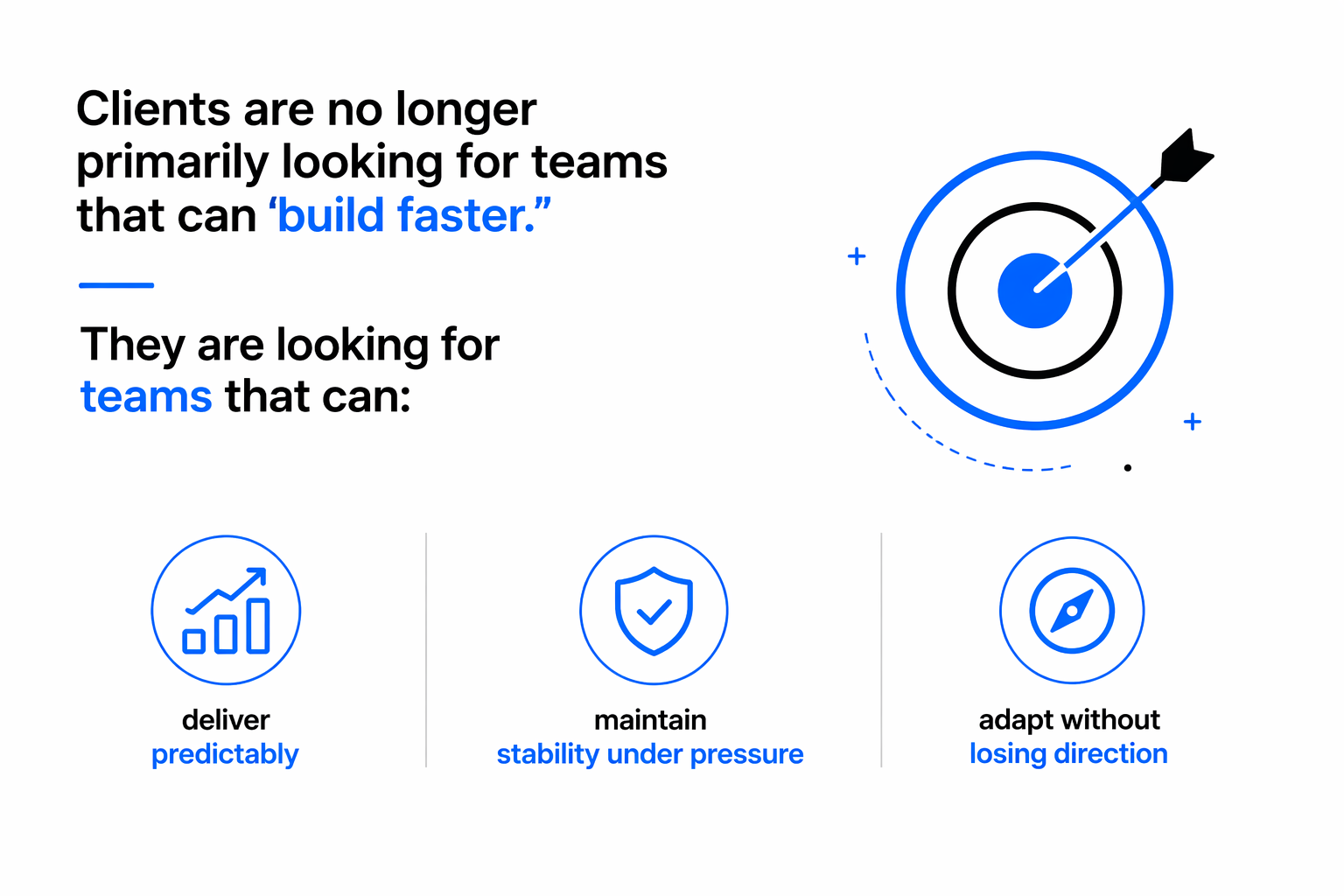
In other words, the value of outsourcing is moving from execution to control.
Teams that understand this shift and combine strong delivery practices with AI become significantly more effective.
Teams that don’t risk becoming faster, but less reliable.
The Real Relationship Between AI and Teams
Framing AI and outsourcing teams as competitors misses the point.
They operate at different levels.
AI improves how work is executed.
Teams ensure that work leads to meaningful outcomes.
Without AI, teams risk inefficiency.
Without teams, AI-driven development risks becoming fragmented and unstable.
The real advantage comes from combining both using AI to accelerate execution, while relying on teams to maintain clarity, accountability, and direction.
Summary
AI is not replacing outsourcing teams, but it is redefining their role.
It removes friction from writing code, but it does not manage delivery.
It generates solutions, but it does not take responsibility for outcomes.
As a result, the importance of teams becomes more visible, not less.
Because as development becomes faster, the need for structure, coordination, and control only increases.
The future of outsourcing is not about competing with AI.
It’s about building teams that can use it effectively without losing sight of what actually drives successful delivery.
And that is what will define how software is built going forward.














No comments yet.
Give us your impression about this article.